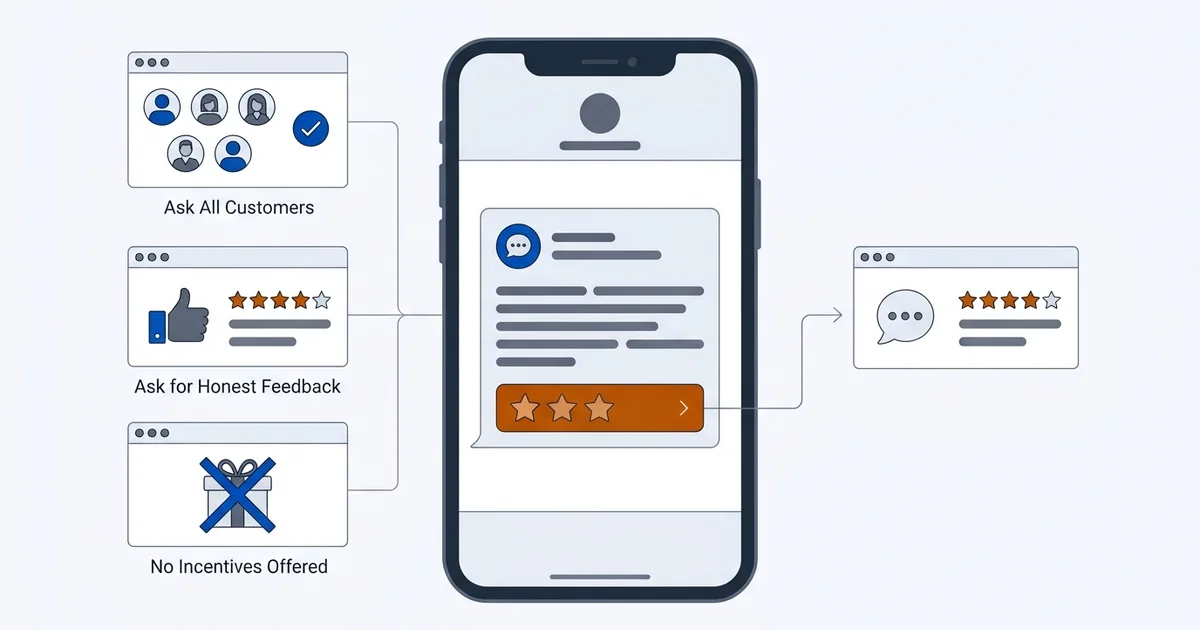
The rules, stated plainly
Three prohibitions cover most of what goes wrong.
No gating. You may not screen customers for satisfaction and only invite the happy ones. Sending a survey first and routing only the five-star respondents to your review link is gating, however it is packaged.
No incentives. No discounts, no entries into draws, no free add-ons, no staff bonuses tied to review counts. This applies to positive and neutral incentives alike.
No writing them yourself. Not you, not staff, not friends, not an agency. Fabricated reviews are the fastest route to losing the ones you earned legitimately.
Beyond those, avoid bulk-soliciting a purchased list and avoid review-farm services offering reviews for a fee.
Lesson 6: reviews, mentions and citations covers why reviews matter to AI answers in the first place, and the guide on how AI reads your reviews explains why the content matters more than the count.
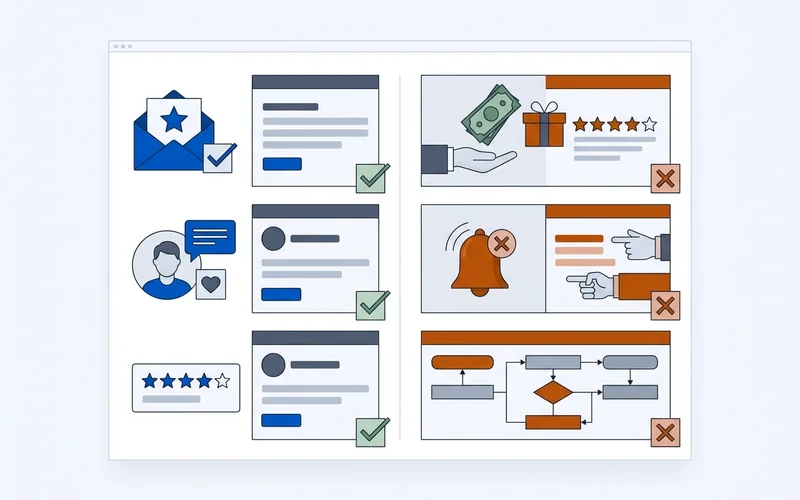
Timing that works
Ask once, at the point the job is finished and the customer has said they are happy. That is the moment when detail is freshest and goodwill is highest.
For work with a delay between completion and the result being visible, such as a repair that needs to prove itself, wait until the customer has had the benefit, then ask. For recurring work, ask after the first job rather than the fifth, and do not ask again.
One reminder, a few days later, is reasonable. A second reminder is pestering.
Wording that works
Short, specific, no pressure, and a direct link.
SMS template.
Hi [name], thanks for having us out today. If you have a minute, a quick Google review really helps other local businesses find us. It helps most if you mention what we worked on and which area you are in. [link] Thanks, [your name] at [business].
Email template.
Subject: Quick favour, if you have a minute
Hi [name],
Thanks for choosing us for [job]. We are a small local business and reviews are how most new customers find us.
If you have a minute, you can leave one here: [link]
If anything was not right, reply to this email and we will sort it out.
Thanks, [your name], [business]
Three things make those work. They are short. They invite specifics without scripting content. And they offer a direct route for an unhappy customer to reply instead of posting, which is not gating because you are not filtering who receives the ask.
Building it into the workflow
The failure mode is not policy, it is forgetting. Pick one trigger and automate the reminder.
- Invoice sent, request goes out the same day.
- Job marked complete in your scheduling tool, request triggered.
- End of week, the person who ran the jobs sends requests for that week.
Consistency beats volume. A steady trickle of reviews looks like an operating business. Twenty in one afternoon after a silent year looks like a campaign, and platform filters agree.
Handling a negative review
- Wait an hour. Nothing written immediately is better than what you write after a walk.
- Reply publicly, briefly, specifically. Name the issue, do not restate their whole complaint, do not argue about interpretation.
- Own what was yours. If you were late, say so and say what changed.
- Correct facts, not feelings. “We attended at 2:40pm, forty minutes outside the window we promised” is a correction. “You are being unfair” is not.
- Move it offline. Offer a direct contact to resolve the substance.
- Do not ask for removal. Resolve the problem and let them decide.
A well-handled negative review is a demonstration of how you behave when something goes wrong, which is information a prospective customer and an assistant can both use.
Keeping it in proportion
Reviews are one of three off-site signals, not the whole game. Once the request routine is running and replies are current, the higher-value work is usually elsewhere: the listing consistency in Lesson 2, or a service page rewrite from Lesson 3.
Why the rules exist, and what breaking them costs
The prohibitions are not arbitrary. Gating and incentives both distort the signal a review is supposed to carry, and platforms invest heavily in detecting them.
The cost of being caught is asymmetric. A filtered batch of reviews can remove legitimate ones alongside the solicited ones. A suspended profile takes weeks to restore and costs you visibility in the meantime. And the pattern that triggers detection, a cluster of similar reviews arriving in a short window, is exactly what an incentive campaign produces.
There is a quieter cost too. Reviews written in exchange for something read differently: shorter, vaguer and more uniform. As the guide on how AI reads your reviews explains, vague reviews carry little usable information, so even a successful incentive campaign buys you the least valuable kind of review.
Building a routine that survives a busy month
The practical failure is not policy, it is consistency. Three patterns that hold up:
Tie it to an existing step. The request goes out when the invoice goes out, not as a separate task somebody has to remember.
Keep one template, lightly personalised. Name the job, keep it to two sentences, include the direct link.
Review the log weekly. Five minutes to check who was asked, who responded and whether anything needs a reply.
If a week gets away from you, send the requests late rather than skipping them. Late is fine. Batching three weeks of requests into one afternoon is not, because that produces exactly the cluster pattern you are trying to avoid.
What to do about an old backlog
If you have been in business for years and have six reviews, do not try to fix it in a fortnight.
Start asking every new customer from today, at the same point in the job. Reply to every existing review, including old ones. Then let it accumulate naturally over a quarter. A slow, steady build reads as an operating business, which is the outcome you actually want.