Assistants quote passages, not pages
Your profile, covered in Lesson 2, answers the standard questions: who you are, where you are, when you open. Everything else a customer wants to know has to live on your site, and it has to be written in a way an assistant is willing to lift.
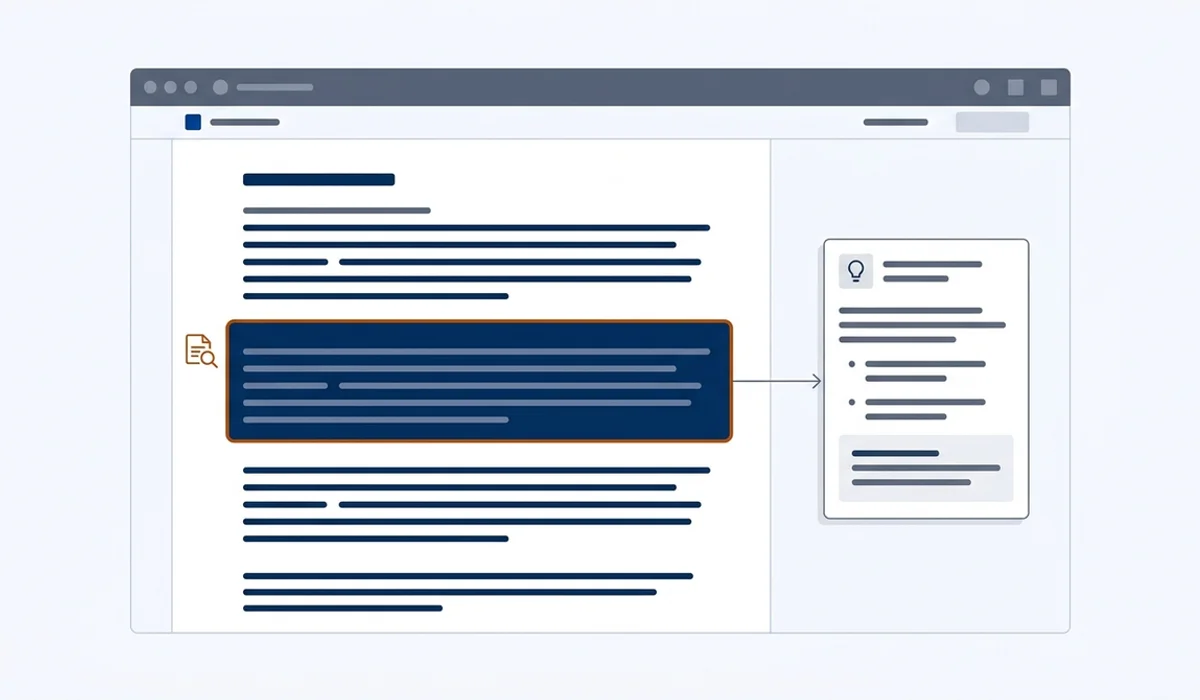
That last part is the whole lesson. Passage-level retrieval means the system is not grading your page as a document. It is looking for a chunk of text that answers the question directly enough to drop into a sentence it is about to write. Your page can be excellent overall and still be skipped, because no single paragraph in it stands on its own.
What a quotable passage looks like
Four properties, and you can check them in about ten seconds each.
It is self-contained. Cut the paragraph out and read it alone. If it starts with “this means that” or refers to something two sections above, it will not survive extraction.
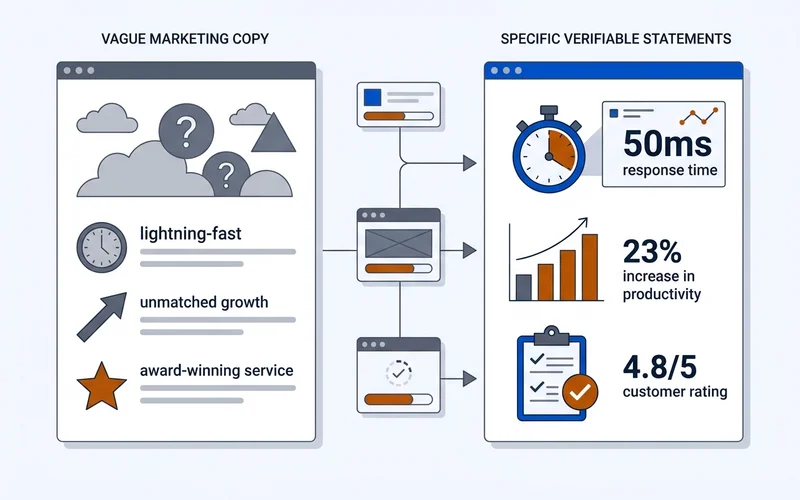
It is specific. “We respond quickly” cannot be corroborated by anything. “We aim to be on site within four hours for emergency callouts in Dandenong, Springvale and Noble Park” can. Semantic search matches meaning, but grounding needs something concrete to attach to.
It is structured. A heading that states the question, an answer underneath, a clean heading hierarchy from H1 down. Retrieval systems chunk text, and clean structure produces clean chunks.
It is dated where it matters. Prices, turnaround times, availability and policies go stale. Saying when a claim was last checked makes it safer to quote and signals that the page is maintained. This is part of what E-E-A-T is getting at in practice: evidence that a real operator keeps this current.
The guide on what makes a page quotable has side-by-side examples of copy that passes and copy that does not.
What gets ignored
The mission statement. The paragraph about your commitment to excellence. The three-sentence intro that says you understand how frustrating a broken cooler is. Not because assistants dislike warmth, but because there is nothing in those sentences to retrieve. They contain no fact, answer no question, and differ from your competitor’s version only in word order.
| Passage type | Why it is retrieved, or not | Example |
|---|---|---|
| Specific and checkable | Contains a fact an engine can ground a sentence on | “On site within four hours across Dandenong and Springvale” |
| Vague reassurance | Nothing to corroborate; identical to every competitor | “We pride ourselves on fast, friendly service” |
| Bundled list page | Too thin per offering to win any single query | Eight services described in two sentences each |
The same goes for pages that bundle everything. A single “Services” page listing eight offerings in two sentences each cannot compete for any of the eight specific queries. One page per service you want to be named for, each answering that service’s real questions, is the structure that works. The comparison of long-form guides and short answer pages covers when to split and when to consolidate.
A before-and-after
Here is the opening of a typical local service page.
Before. Welcome to our website. We are a family-owned business with many years of experience serving our local community. Our team of highly trained professionals is committed to delivering exceptional service at competitive prices. Customer satisfaction is our top priority. Contact us today for a free quote.
Five sentences, zero facts. Nothing there can be quoted, because nothing there can be checked.
After. We repair commercial refrigeration for restaurants, cafes and small food retailers across Dandenong, Springvale and Noble Park. Emergency callouts are attended within four hours during business hours, and most compressor faults are diagnosed on the first visit. Standard callout is $180 including the first hour on site, with parts quoted before work starts. We have been trading since 2011 and hold a current refrigerant handling licence.
Same business, same claims, but now every sentence contains something an engine can attach an answer to: a service type, named areas, a response window, a price, a trading history, a licence. An assistant asked “who repairs commercial fridges in Springvale” has something to work with.
Notice what it does not do. It does not promise the best service in the state. It does not say “affordable”. It does not hide the price behind a form.
Structure a service page like this
- What this is, in one sentence. The service, the customer type, the area.
- What it costs. A range, plus what moves it. If pricing genuinely varies, say what it depends on.
- What is included. A list, written the way a customer would describe it.
- How it works. Three to five steps with a realistic timeframe attached.
- Who it is for, and who it is not. Ruling yourself out of the wrong jobs makes you easier to name for the right ones, and helps entity disambiguation when several businesses share a category.
- The five questions you get asked most. Written as headings, answered in the first sentence.
- Proof. Licences, insurance, years trading, a named example if you have permission.
The guide on writing a service page an AI will cite walks through the same structure with a full worked example.
Say the awkward things plainly
Two areas where owners hedge, and both cost citations.
Service area. “We serve the greater metro area” is unusable. Name the suburbs or towns. If you charge a travel fee past a certain point, say where that line is. This also keeps your site consistent with the service areas on your profile, which matters for the reasons Lesson 2 covered.
Pricing. You do not have to publish a full price list. You do have to give a reader something. A range, a callout fee, a typical job cost, or an explicit “here is what moves the price”. A page that says nothing about cost loses the query to one that says something, every time.
What to do next
Pick your single most commercially important page and rewrite it against the structure above. One page, done properly, teaches you more than skimming this lesson twice.
Then move to Lesson 4, which takes the facts you have just written in prose and states them again in a form engines cannot misread.