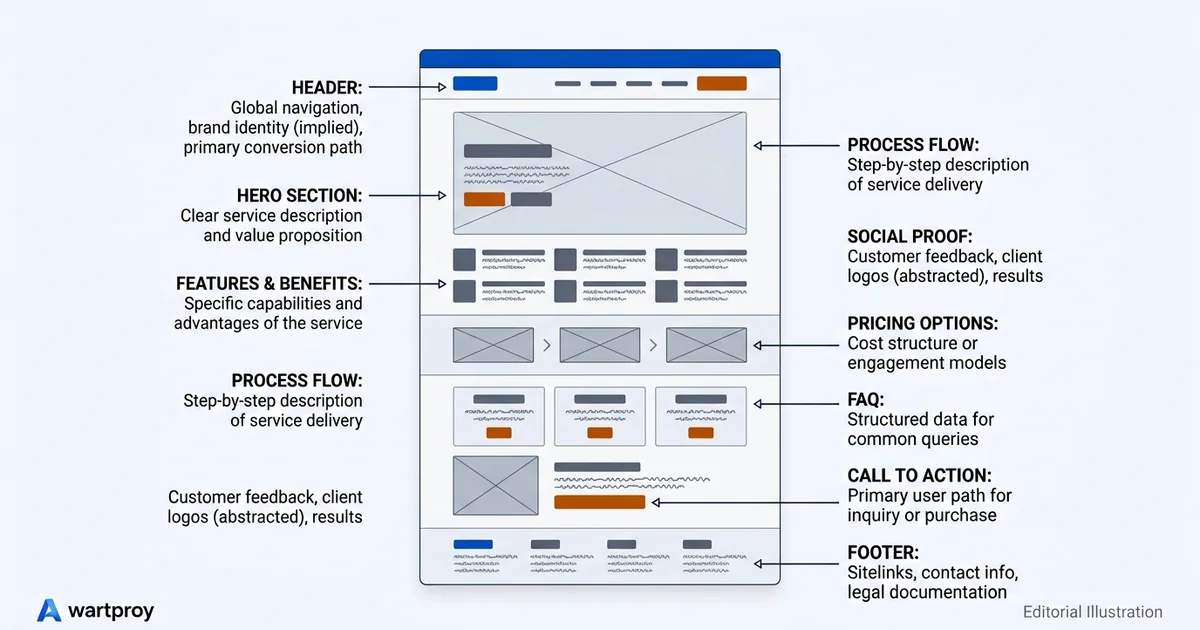
Start from the questions, not the layout
A service page has one job: answer the questions a buyer asks before booking, in a form both a human and an assistant can use. Everything else is decoration.
Before writing, list the five questions you get asked most on the phone about this service. Those are your headings. The passage-level principles behind this are in Lesson 3: local site content AI can cite, and the test for an individual paragraph is in the guide on what makes a page quotable.
The structure
1. What this is, in one sentence. The service, the customer type, the area. This is the passage most likely to be lifted, so make it complete: “We repair commercial refrigeration for cafes, restaurants and food retailers across Dandenong, Springvale and Noble Park.”
2. What it costs. A range, plus what moves it. If pricing genuinely varies, say what it depends on: unit type, access, parts availability, out-of-hours. Vagueness here loses more citations than any other omission.
3. What is included. A short list in customer language, not trade jargon. Include what is explicitly not included, since that answers a question people are too polite to ask.
4. How it works. Three to five steps with realistic timeframes. “We attend, diagnose on site, quote before any work starts, and complete most repairs in the same visit if the part is on the van.”
5. Who this is for, and who it is not. Ruling yourself out of the wrong work makes you easier to name for the right work. “We do not service domestic fridges” is a useful sentence for everyone involved.
6. The five questions. Each as a heading, answered in the first sentence beneath it.
7. Proof. Licences, registrations, insurance, years trading, a named example where you have permission.
8. What to do next. One clear action, with the contact method you actually answer.
A worked example
Here is the “what it costs” section of a real-shaped page, before and after.
Before. “We offer competitive pricing on all refrigeration repairs. Every job is different, so contact us today for a free, no-obligation quote tailored to your needs.”
After. “Standard callout is $180, which includes the first hour on site and diagnosis. Most thermostat and fan replacements finish inside that hour. Compressor work typically runs $600 to $1,400 depending on the unit, and we quote parts before ordering. Out-of-hours attendance adds $120. Prices current as of September 2026.”
The second version answers the question. It also gives an assistant something to state, which is the mechanism by which you get named rather than skipped.
What to cut
The welcome paragraph. Nobody arrives at a service page wanting a greeting.
The mission statement. It is interchangeable with every competitor’s.
Repeated keyword phrases. Semantic retrieval does not reward them, and readers notice.
Stock reassurance. “Fully insured for your peace of mind” says less than “Public liability cover to $20m, certificate available on request.”
Everything about a different service. Link to that page instead.
Structure notes that matter
One H1, stating the service and the area. H2s for each question. No skipped levels. Short paragraphs, because a wall of text chunks badly and reads worse on a phone.
If you publish prices, add a visible last-updated date near them. It makes the claim safer to quote and signals maintenance, which matters when an engine is choosing between two similar sources.
Finally, make sure the facts on this page agree with your business profile and your structured data. A page stating hours your profile contradicts creates exactly the problem Lesson 2 told you to eliminate, and Lesson 4 covers stating the same facts in JSON-LD.
Do one page first
Pick the service that earns you the most money and rewrite that page only. Publish it, then run your prompt test a few weeks later, using the method in Lesson 7. One completed rewrite with a measurable outcome is worth more than five half-finished ones.
Answering the top buyer questions on the page itself
Most service pages describe. The ones that get quoted answer.
Across local service businesses the same five questions come up before a booking, whatever the trade:
- Do you do this specific thing? Named plainly, in the customer’s words.
- Do you cover where I am? Named suburbs or towns, plus travel terms.
- What will it cost? A range and what moves it.
- How soon can you come? A realistic window, not “promptly”.
- Can I trust you? Licences, insurance, years trading, a concrete example.
Turn each into a heading and answer it in the first sentence underneath. That single move does more for retrieval than any amount of keyword work, because it produces five self-contained passages where there were none.
If you get a sixth question repeatedly on the phone, add it. If a section on your page answers nothing anybody asks, it is decoration.
Common failure modes in a rewrite
Answering in the second paragraph. The setup sentence reads well to a human and buries the answer for extraction. Put the answer first, then explain.
Hedging the price into meaninglessness. “Every job is different” is true of every business in your trade and tells a reader nothing. State a typical range and the factors that move it.
Writing the service area as a region. “Greater metro area” cannot be matched against a customer’s suburb. Name the places.
Adding an FAQ block full of vague answers. The format does not rescue the content. A question-shaped heading over marketing copy is still marketing copy.
Leaving contradictions with the profile. If the page says you open at seven and your profile says eight, you have created the exact problem Lesson 2 exists to prevent. Check both before publishing.
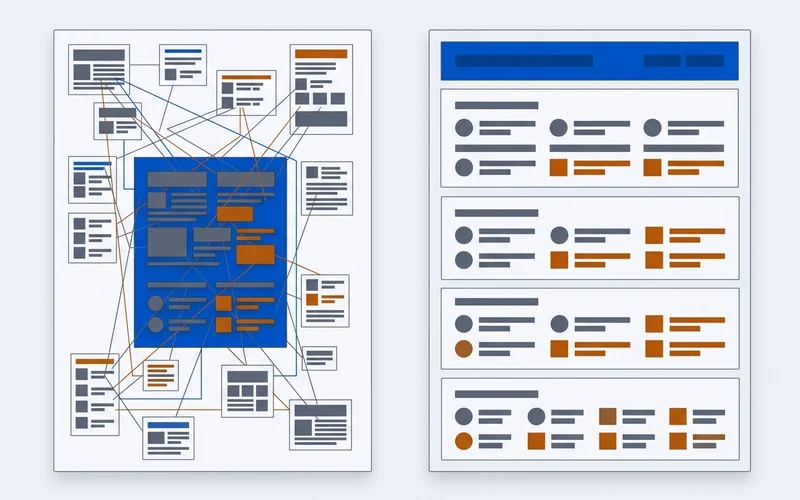
Before and after, at page level
The rewrite is easier to picture as a structural change than as a copy change.
Before. Hero image with a slogan. Two paragraphs of welcome. A bulleted list of eight services with no detail. A block about values. A contact form. Around 400 words, none of which answers a buyer question specifically.
After. An opening sentence naming the service, the customer type and the areas covered. A pricing section with a range and the factors that move it. A what-is-included list in plain language, with exclusions stated. A four-step process with realistic timeframes. A short who-this-is-not-for paragraph. Five question headings with direct answers. A proof block with licence and insurance details. One clear next step. Around 900 words, every one of them doing a job.
Same business, same facts, restructured so that a customer can decide and an assistant can quote. Nothing in the second version is invented: it is information the owner already had in their head and on the phone every day.
That is usually the case, which is why the rewrite is cheaper than it sounds. The hard part is not writing, it is deciding to state prices and service areas plainly, which is the decision Lesson 3 keeps pushing you towards.