Length is the wrong question
Owners and agencies keep asking how long a page should be. The question persists because word count is easy to measure and clarity is not.
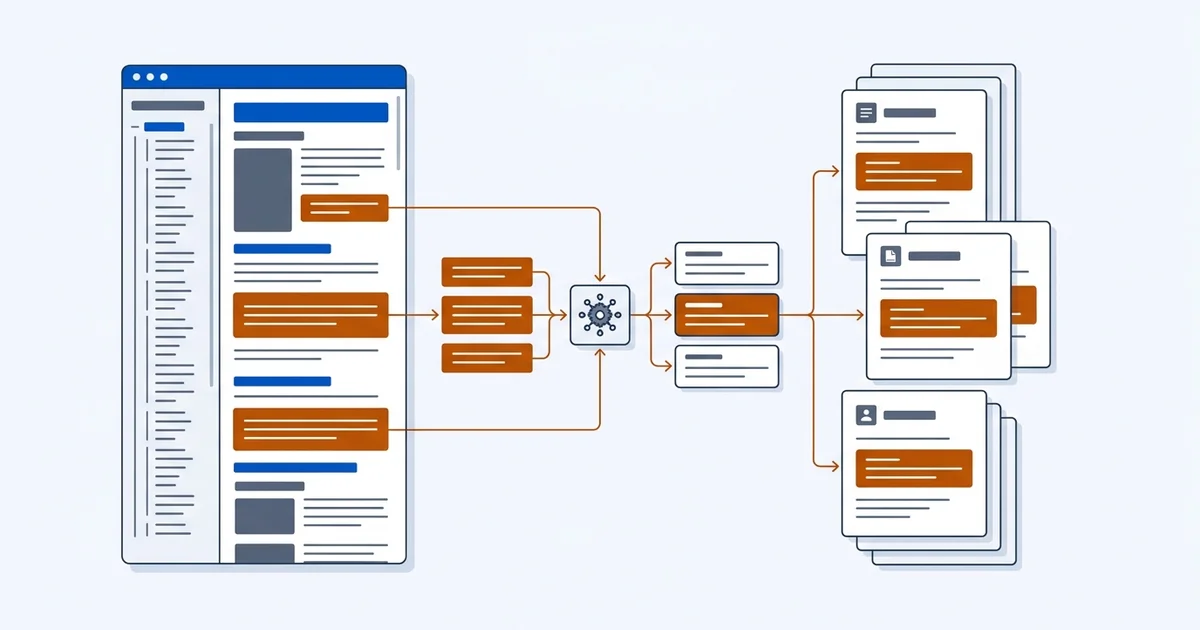
As Lesson 3: local site content AI can cite explains, retrieval works at passage level. A system looking for an answer to “what does a commercial fridge repair callout cost in Dandenong” wants a passage that answers that. It does not care whether the passage sits inside a 600-word page or a 3,000-word guide, except insofar as length affects how cleanly the passage can be isolated.
So the real question is: how many distinct questions does this page answer, and can each answer be extracted?

What each format is good for
Short answer pages work when a question is self-contained and commercially meaningful. They are easy to keep current, easy to link to, and the answer is obvious to find. The risk is thinness: a page that answers a question in one sentence with no supporting detail gives an engine little reason to prefer it.
Long-form guides work when a topic genuinely has connected parts that a reader needs in sequence, or when you are demonstrating depth on something your competitors treat superficially. The risk is burial: five good answers lost inside three thousand words of context, none of them clearly delineated.
Both formats can be cited. Both fail in predictable ways.
A decision rule
Ask two questions about the topic.
How many distinct buyer questions does it cover? One or two, short page. Five or more, long guide with clear headings, or a small cluster of pages.
Would a reader arrive wanting all of it, or one part of it? A reader comparing options wants the whole comparison. A reader asking what something costs wants the number.
If you are still unsure, default to the shorter, more focused page. It is easier to expand a focused page later than to unpick a bloated one.
How to split a bloated page
Splitting goes wrong when it produces two pages competing for the same query. Done properly:
- List the questions the page currently answers. Be honest about which ones it answers well.
- Identify the primary one. That stays on the original URL, which keeps whatever standing the page has.
- Move genuinely separate questions to their own pages. Each needs enough substance to stand alone, which usually means it answers the question and gives the supporting detail.
- Link them together. The main page links out to each child page; each child links back with descriptive anchor text.
- Redirect anything you remove. If a URL disappears, point it at the closest equivalent.
That structure, one main page plus focused supporting pages, is exactly how this course is built: a lesson with guides underneath it. It signals coverage without producing duplicates.
Consolidating instead
The opposite move is sometimes right. If you have four thin pages that all half-answer the same question, merge them into one page that answers it properly and redirect the rest. Four weak passages compete with each other; one strong passage does not.
The test is the question, not the topic. Two pages about pricing that answer different questions, such as what it costs versus what moves the price, can coexist. Two pages both trying to answer what it costs cannot.
What to do with this
Whatever length you choose, apply the extraction test from the guide on what makes a page quotable to each paragraph. Length is a consequence of how many questions you are answering. It was never the input.
What each format costs to maintain
Length has an ongoing cost that rarely appears in the decision.
A short answer page is cheap to keep current. When a price changes or a policy shifts, you edit one passage and you are done. A long guide accumulates claims, and the claims go stale unevenly: a price from two years ago sitting in section four of a 3,000-word document is the kind of error nobody notices until a customer quotes it back to you.
That maintenance burden is a legitimate input to the decision. If you are a single-operator business with limited time, several focused pages you can actually keep accurate will outperform one impressive guide you will never revisit. The maintenance rhythm in the guide on what to do after the 90-day checklist assumes pages you can re-read in a sitting.
A worked decision
A mobile locksmith is deciding how to cover emergency lockouts.
One long guide covering lockouts, key cutting, lock replacement, security upgrades and insurance requirements would run to several thousand words. Each topic would get a section. None would be the obvious answer to a specific query, and the page would be hard to keep current across five price structures.
Several short pages, one per service, each answering the five buyer questions for that service, would produce clear retrieval targets. The emergency lockout page can state a callout fee, a response window and an after-hours surcharge, and all three can be updated in one edit when they change.
The second structure wins here, and it usually wins for service businesses. The exception is a topic where a reader genuinely needs the parts in sequence, such as a step-by-step process where the earlier steps determine the later ones. There, a single guide with clear headings is the honest shape, and the extraction test from the guide on what makes a page quotable applies to each section within it.