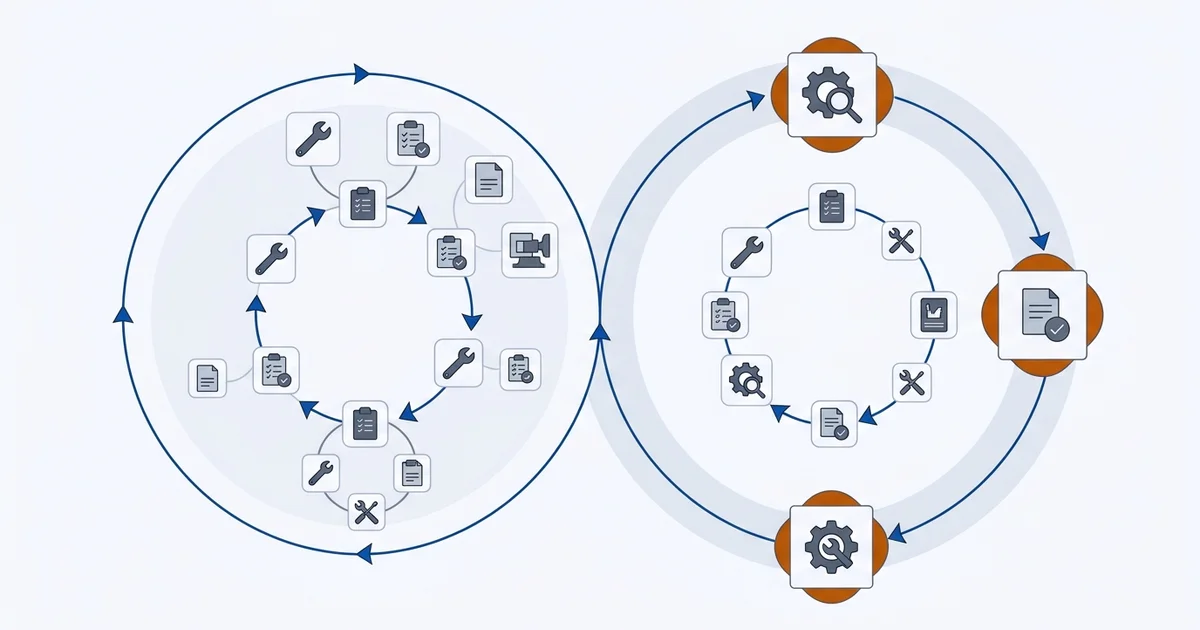
The work changes shape, it does not stop
Lesson 8: where to go next closes the course by saying that stopping at foundation level is a legitimate outcome for many businesses. This guide is what “stopping” actually looks like in practice.
Finishing the 90-day checklist means your facts agree, your key pages are quotable, your markup validates and you have a measurement routine. That is the foundation.
What replaces the project is a maintenance loop. It is small, and it is the difference between a foundation that holds and one that quietly decays over a year.
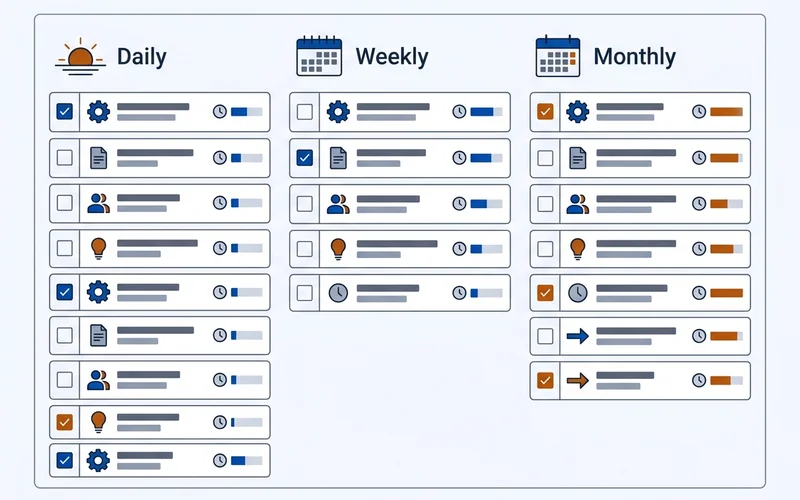
The monthly loop, 30 to 60 minutes
| Task | Time | Definition of done |
|---|---|---|
| Check hours against next month’s calendar | 5 min | Special hours entered at least two weeks ahead |
| Call your own public number | 1 min | It rings where it should |
| Reply to unanswered reviews | 15 min | Nothing from the last month is unanswered |
| Run the prompt test | 15 min | Results logged with the date and conditions |
| Pick one action from the test | 10 min | One change identified and scheduled |
That is it. The prompt test method is in the guide on testing whether ChatGPT recommends your business, and the cadence reasoning is in the guide on how often to re-check.
The quarterly loop, about an hour
- Re-read your top three pages. Are the prices still right? Is the service list current? Is anything now inaccurate?
- Check the structured data still validates. Especially after any site or plugin update.
- Check your server logs for AI crawlers. Confirm they are still arriving and getting 200 responses.
- Scan for new listings of your business. Someone else may have created one, and it will not match your canonical record.
- Compare the quarter’s prompt test results. Look at the pattern across three months, not the last reading.
Twice a year, half a day
Run the full listing audit from the NAP consistency guide: search your name, your phone number and any old address, and reconcile every source against your canonical record. Six months is long enough for drift to appear and short enough to catch it before it propagates widely.
Signs the foundation has slipped
- An assistant starts hedging about your hours again.
- A customer mentions a number or address you no longer use.
- Your prompt test results decline across two consecutive months with no obvious cause.
- Search Console shows a query shift you cannot explain.
- Your structured data stops validating after a site update.
- AI crawlers disappear from your logs.
Each of these has a specific cause and a specific fix, and each traces back to a lesson in the course rather than to anything new.
What to add once maintenance is stable
Only after the loop is genuinely running, and only if you want to:
Add depth where customers ask. A new page for a service you keep getting called about, written to the standard in Lesson 3.
Earn one genuine mention a quarter. The hardest and most differentiated work, covered in Lesson 6.
Tighten your entity data. Add profiles you genuinely own to your sameAs list as they appear.
Notice what is not on that list: publishing weekly blog posts, chasing more directories, or adding location pages for towns you rarely work in. Those are ways of feeling busy.
Handing it over
The loop is written so somebody else can run it. Give them the canonical record document, the prompt set, the logging sheet and the definitions of done above. Then verify the output monthly rather than redoing the work.
If you reach the point where maintenance is stable and growth now depends on scale or displacing a stronger competitor, that is the ceiling question, and the guide on when foundation-level AI SEO stops being enough covers how to judge it.
A note on what not to add
The most common mistake after finishing the checklist is filling the gap with activity.
Weekly blog posts. Unless you have genuinely time-stamped news, evergreen educational content belongs in focused pages, not a chronological feed. A post nobody searches for and nothing links to is maintenance you have volunteered for.
More directory listings. The returns flattened at around a dozen quality citations. Past that, each new listing is another place your details can drift.
Location pages for towns you rarely work in. Thin pages compete with your strong ones and dilute the topic.
A visibility tool subscription. At one location, the manual monthly test covers what you need, as Lesson 7 explains.
Re-running the whole checklist quarterly. It is a setup exercise. The quarterly loop above is what replaces it.
If you find yourself looking for something to do, the honest answer is usually that the foundation is done and the time is better spent on the business itself. That is a legitimate place to stop, and Lesson 8 says so.