What other people say about you often outweighs what you say
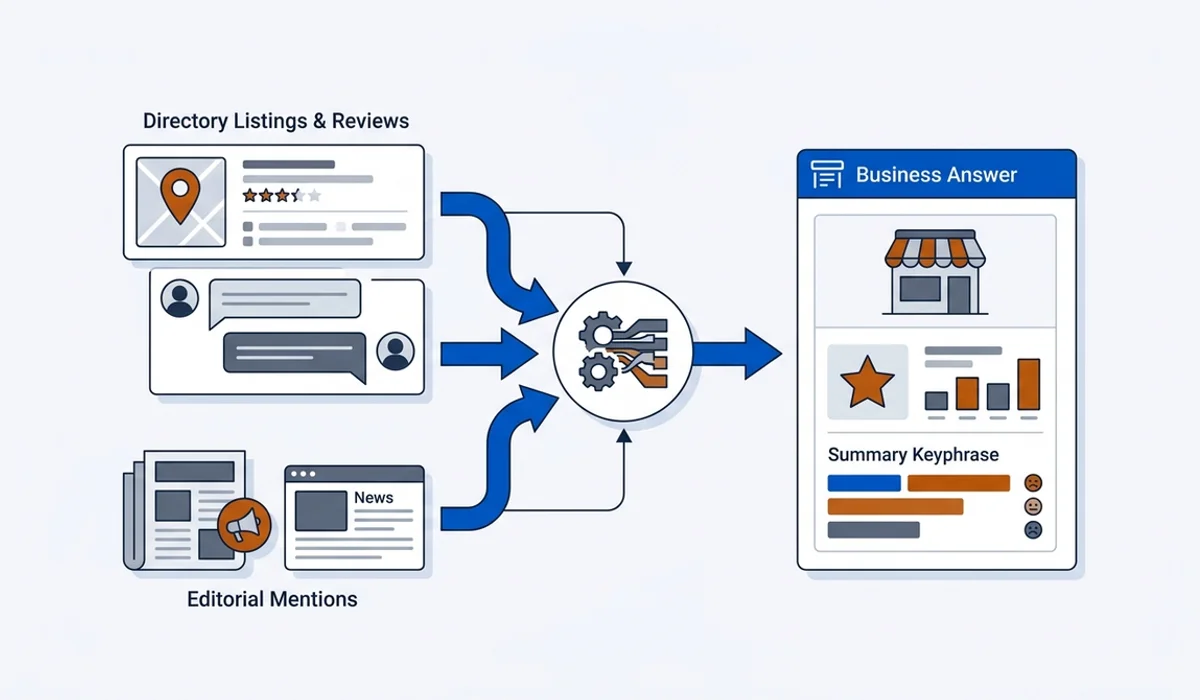
Lessons 2 to 5 covered assets you control. This one covers the rest of your footprint, which is where a surprising amount of the decision gets made. When an assistant is choosing between two similar businesses, independent corroboration is the tiebreaker, because your own site is the one source that is guaranteed to be flattering.
Three kinds of off-site signal matter: reviews, structured citations and unstructured mentions. They work differently and they are worth different amounts of your time.
How AI reads reviews
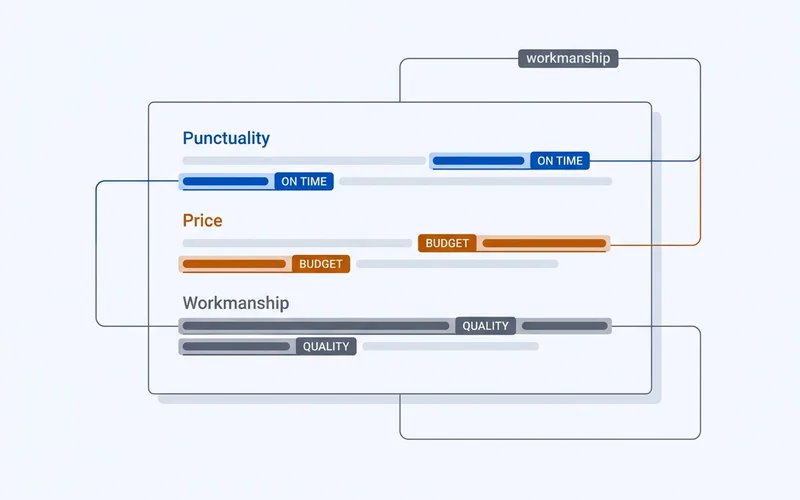
Not as a star average. Modern systems run aspect-based sentiment analysis, which pulls out the attribute being discussed and the sentiment attached to it. A review that says “arrived on time, explained the fault before touching anything, and the price matched the quote” produces three usable attributes: punctuality, communication, pricing accuracy.
A review that says “great service, highly recommend” produces nothing extractable. It counts towards your average and that is all it does.
This is why a handful of specific reviews beats a pile of generic ones. It also explains the pattern effect: one angry review among forty calm ones is an outlier. Four reviews across six months all mentioning the same missed appointment window is a theme, and a theme is what gets repeated in an answer. The guide on how AI reads your reviews goes deeper on which attribute words recur for local trades.
Review velocity matters in a mild way. A steady trickle looks like an operating business. Twenty reviews in one afternoon after eighteen months of silence looks like a campaign, and platform filters agree.
Asking for reviews without breaking the rules
The rules are short and worth knowing exactly, because the penalties are worse than the shortfall.
You may not gate, meaning you may not screen for happy customers and only ask those. You may not incentivise, including discounts, entries into draws or free add-ons. You may not write them, and you may not have staff write them. You may not bulk-solicit from a purchased list.
What works instead is unglamorous. Ask everyone, at the same moment, in the same way. The best moment is right after the work is finished and the customer has said they are happy. Keep the message to two sentences and a direct link. Then reply to what arrives, including the negative ones, calmly and with specifics.
The guide on asking for reviews compliantly has SMS and email templates you can adapt, plus how to handle a bad review when it lands.
One thing you may do: invite specifics honestly. “If you have a moment, it helps other people if you mention what we worked on and which area you are in” is a legitimate request. Scripting the review is not.
Citations versus mentions
A structured citation is a listing of your name, address and phone on another site: a directory, a trade body, a chamber listing, an aggregator record. Its job is corroboration of your facts, which makes it an extension of the NAP consistency work in Lesson 2.
An unstructured mention is your business name in ordinary text: a local news piece, a supplier’s case study, a community group’s thank-you post, a forum answer. It carries different information, usually about what you did rather than where you are.
| Structured citation | Unstructured mention | |
|---|---|---|
| What it corroborates | Your facts: name, address, phone | What you do and how you are regarded |
| How you get it | Claim or submit a listing | Earn it, or be the person who answers |
| Where returns stop | After roughly a dozen quality listings | Rarely, because few competitors do it |
Both reach an answer, by different routes. The mistake is assuming more citations always means more visibility. It does not. Returns flatten quickly once the major data aggregators such as Data Axle, Neustar Localeze and Foursquare are correct and the obvious platforms are claimed. Past that point, extra low-quality directories mostly create new opportunities for your details to drift out of sync.
The comparison of citations and brand mentions sets out where to spend your next ten hours, which for most businesses is two or three genuine mentions rather than thirty more listings.
Where it is actually worth being listed
Work down this list and stop when it stops being genuine:
- The major data aggregators, because smaller directories refresh from them.
- The platforms your customers actually use, which may include Yelp for Business, a trade-specific directory, or a booking platform in your sector.
- Your local Chamber of Commerce or equivalent, if you are a member.
- Trade associations and licensing bodies you genuinely belong to.
- Suppliers and manufacturers who list approved installers or stockists.
- Better Business Bureau or the local equivalent, where it has real standing in your market.
Then stop. A business with six accurate, relevant listings is in better shape than one with sixty inconsistent ones.
Earning mentions without a PR budget
Mentions are harder to manufacture, which is exactly why they carry weight. Three approaches that work for small local businesses:
Be the source. Local journalists and trade publications need someone who can explain a seasonal problem in plain language. Answering promptly once gets you called again.
Be useful to an organisation. Sponsoring a junior team, running a free clinic session, or fixing something for a community group produces a genuine mention on a site with local standing.
Be listed by people you work with. Suppliers, manufacturers and partner trades often maintain lists and will add you if you ask.
None of this scales, and that is the point.
What to do next
Set the review routine up properly, reply to your backlog, and pick two places where a mention would be genuine. Then move to Lesson 7, which is about telling whether any of the last six lessons actually landed, and what still cannot be measured.