
The honest test
Most businesses reading this have not outgrown foundation level. They have skipped part of it.
So before deciding anything, check the four conditions:
- Your facts agree everywhere. Profile, site, aggregators and the directories that matter all carry the same name, number, address or service areas, and hours.
- Your key pages are genuinely citable. Each one answers real buyer questions in self-contained passages with checkable facts.
- Your structured data validates and matches. No contradictions between markup, page and profile.
- You have three months of dated prompt test results. Not impressions, results.
If all four are true and progress has stalled, you have a ceiling problem. If any are false, the highest-value work is still in the course, and Lesson 8: where to go next says so plainly.
Signals that you have genuinely outgrown it
- You operate across several markets and need location-level management rather than one profile.
- You are consistently named for your own brand and category, but never for the highest-value competitive queries.
- Your competitors have also done the foundation work, so the differentiator has moved elsewhere.
- You need to manage this across multiple clients and manual testing no longer scales.
- Growth now depends on producing many pages from structured data without creating thin duplicates.
Those are scale and competition problems. They are real, and they are outside what this course teaches.
What advanced work actually involves
Not secrets. Mostly heavier versions of the same principles:
Multi-location entity management. Distinct profiles, distinct pages with genuinely distinct content, consistent entity relationships between them, and reporting per location.
Programmatic page generation. Building many pages from a data source while keeping each one substantive enough to earn its existence. The failure mode is obvious and common.
Competitive displacement. Understanding why a specific competitor is cited for a specific query and building something demonstrably better, rather than the same thing again.
Systematic mention acquisition. Treating third-party mentions as a repeatable process rather than an opportunistic one.
Tooling at scale. Automated prompt testing across many locations, which is where paid tools start to earn their cost.
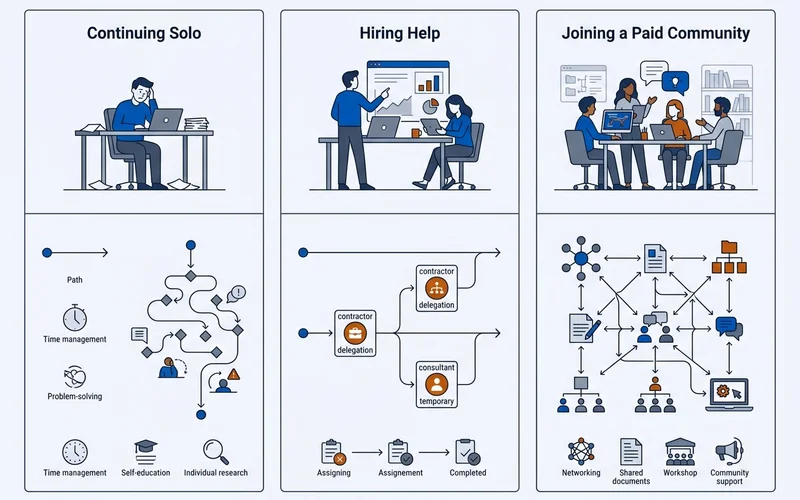
Three paths, honestly compared
| Continue solo | Hire help | Join a paid community | |
|---|---|---|---|
| Cost | Your time | Monthly fee or project cost | Subscription |
| Best when | Maintenance is stable and you enjoy it | Time is the constraint, not knowledge | You want to learn advanced work yourself |
| Risk | Slow progress, missed changes | Paying for activity, not outcomes | Paying for access you do not use |
| How to judge it | Are results improving over quarters? | Did they name specifics in the first 30 days? | Are you applying what you read? |
The disclosed referral
For readers who genuinely need the advanced territory, this course points to AI SEO Rainmakers, a paid community run by Charles Floate and hosted on Skool. It covers multi-market work, programmatic approaches and competitive tactics.
Disclosure: the link from this course is a Skool referral link, and a referral is credited to this site if you join through it. It is disclosed here, in Lesson 8, on the about page and in the editorial policy. It is not affiliated with LocusPilot, and it is not the right answer for most single-location businesses.
Questions to ask before paying anyone
- What would you change in the first 30 days, specifically?
- How would you measure whether it worked, and what are the limits of that measurement?
- What would you deliberately not do for a business like mine?
- What does month four look like, once the obvious fixes are done?
- Can you show me a business like mine where this worked, and what the starting point was?
Specific, bounded answers are the signal. If someone promises AI citations or a guaranteed visibility score, that is the point to stop.
Or simply stop
For a single-location service business with clean facts and a stable maintenance loop, stopping is the correct answer more often than the industry admits. Keep running the routine in the guide on what to do after the 90-day checklist and spend the reclaimed hours on the business itself.
A worked judgement call
Two businesses, same question, different answers.
A single-location dental practice. Profile complete, listings consistent, three service pages rewritten with prices and specifics, markup validating, six months of prompt test results showing steady improvement and correct facts in every answer. Growth has slowed, but the practice is at capacity three days a week.
The honest answer here is stop. There is no visibility problem to solve. Keep the maintenance loop from the guide on what to do after the 90-day checklist and spend the time elsewhere.
A three-location cleaning company. Foundation complete at each location, but profiles are managed inconsistently by different staff, location-level reporting does not exist, and the same national competitor is named in every market.
That is a genuine ceiling. The problems are scale and displacement, both outside what this course teaches, and both worth paying for help with if the revenue justifies it.
The distinguishing question is not how hard you have worked. It is whether the remaining constraint is something foundation-level work can still move.
Before you spend anything
Three cheap moves that often reveal the ceiling was not the problem.
Re-read your own prompt test log. If you are absent on specific service queries, that is a content gap, not a scale problem.
Check the sources being cited. If your own pages never appear, your pages are the constraint.
Re-run the listing audit. A single contradictory record can suppress results in a way that looks, from the outside, exactly like needing an expert.
Spend an hour on those before spending money on anything.