Three terms, one work list
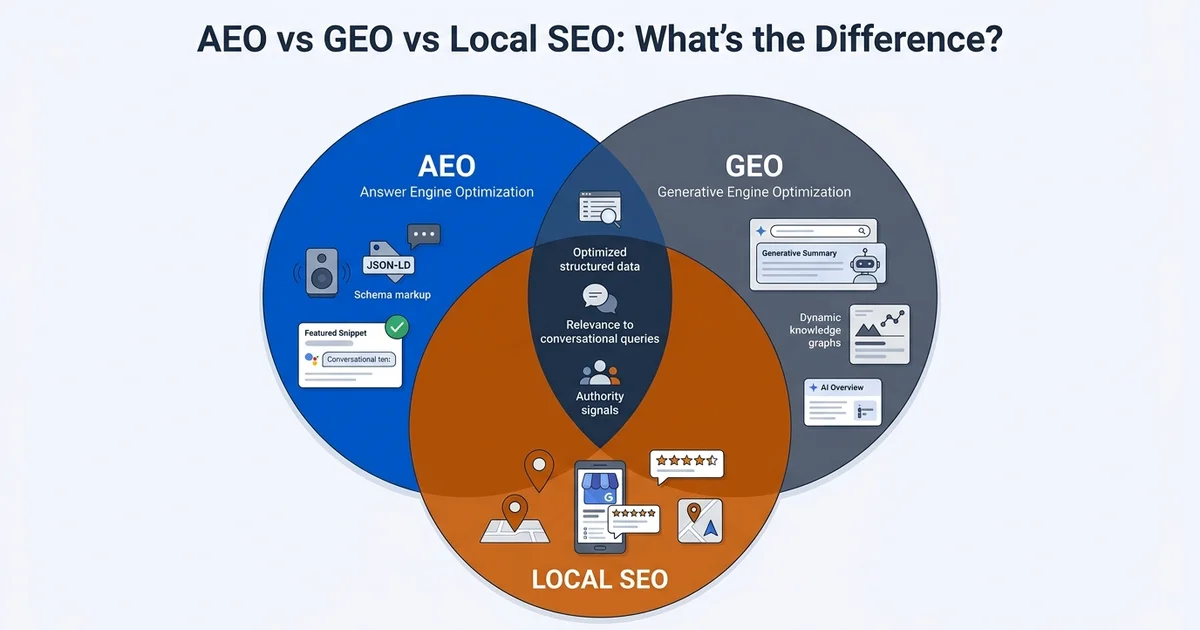
You will be pitched all three, sometimes by the same person in the same meeting. All three describe work aimed at the same mechanism, the one explained in Lesson 1: how AI search picks local businesses. Here is what each term actually means.
AEO, Answer Engine Optimization. Optimising so an answer engine states your business as the answer rather than listing your link. The term predates the current AI wave and was originally about featured snippets and voice results.
GEO, Generative Engine Optimization. Optimising so generative systems understand your business well enough to name it inside a written answer. The fuller definition is in what GEO means.
Local SEO. Making a local business findable in search, historically through profile completeness, citation consistency, on-page relevance and reviews.
The mechanics that make all three work are the same: an answer is assembled from retrieved documents, so the quality and consistency of those documents decides who gets named.
Where they overlap
Almost everywhere. Compare the actual task lists:
| Task | Local SEO | AEO | GEO |
|---|---|---|---|
| Complete and verify your business profile | Yes | Yes | Yes |
| Make name, address and phone consistent everywhere | Yes | Yes | Yes |
| Write pages that answer real customer questions | Yes | Yes | Yes |
| Structure answers so a passage stands alone | Sometimes | Yes | Yes |
| Add LocalBusiness structured data | Yes | Yes | Yes |
| Earn reviews and third-party mentions | Yes | Yes | Yes |
| Keep the site crawlable and fast | Yes | Yes | Yes |
| Set AI crawler permissions deliberately | No | Sometimes | Yes |
| Measure by prompt testing rather than rank tracking | No | Sometimes | Yes |
Two rows differ meaningfully. Everything else is the same work, and that is the point of this guide.
What actually changed
Three genuine shifts, none of which require a new discipline.
The unit of value. A position in a list has become a mention inside a sentence. That changes how you measure, which is why Lesson 7 uses a prompt test rather than a rank tracker.
The extraction level. Retrieval pulls passages, so a page that reads well overall but contains no self-contained answer gets skipped. That is a writing change, not a strategy change.
The new control surface. AI crawler permissions did not exist a few years ago. Setting them deliberately is covered in Lesson 5.
How to read a proposal that uses these terms
Ask three questions and listen for specifics.
What would you change in my first 30 days? Good answers name your profile fields, specific pages and specific listings. Weak answers talk about authority, visibility and holistic optimisation.
How would you measure it? Good answers describe a fixed prompt set run under consistent conditions, plus Search Console signals, with the limits acknowledged. Weak answers promise a citation score with no explanation of how it is derived.
What would you deliberately not do? Good answers rule things out, such as chasing low-quality directories or publishing thin location pages. An operator with no exclusions is describing a package, not a plan.
What a local business should care about
Not the acronym. The four things underneath all three labels: facts that agree everywhere, pages that answer real questions specifically, structured data that removes ambiguity, and third-party corroboration that backs it up.
That is the whole of this course, sequenced in the 90-day checklist. If a provider’s work list matches that and goes further in ways they can explain, the label on the invoice is irrelevant. If it does not, the label is the product.
Why the distinctions get sold so hard
It helps to understand the incentive. A new acronym creates a reason for a new engagement, a new package and a new budget line. If the work were described plainly as “complete your business profile, fix your listings, rewrite three pages and add structured data”, it would be harder to price as a specialism.
That does not make the field fraudulent. The underlying shift is real, and there are genuine practitioners doing genuine work under all three labels. It does mean the label carries no information, and you should ignore it when evaluating who to work with.
A second reason the terms multiply: they let a provider avoid measurement. Rankings were measurable and uncomfortable. “AI visibility” is fuzzy enough that almost any report can be assembled to look like progress. Insist on a method you can reproduce yourself, such as the fixed prompt test in Lesson 7.
What to do this month, regardless of the label
Four actions that serve AEO, GEO and local SEO simultaneously, because they are the same work:
- Audit your listings for contradictions. One afternoon, and it is the highest-leverage task available.
- Rewrite your most valuable page so each section answers one question in its first sentence.
- Publish a price range on that page, with the factors that move it.
- Run a baseline prompt test and save the result with the date.
If a provider’s proposal would have you doing something other than those four in month one, ask them to explain why. There may be a good reason. There may also be an acronym.