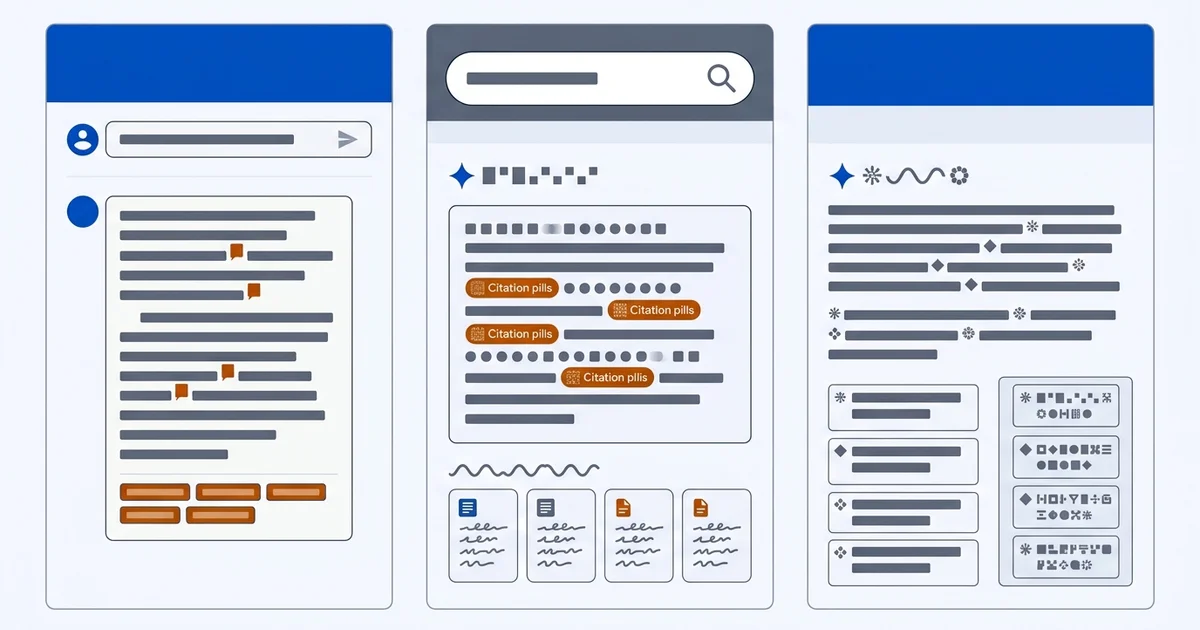
Same mechanism, different source mixes
All three engines follow the sequence described in Lesson 1: how AI search picks local businesses: interpret the query, retrieve documents, ground the answer, cite sources. What differs is which documents they reach for first, and how they present the result.
This matters when you have limited hours and want to know where they go. The short answer is that the overlap is large enough that engine-specific optimisation is rarely worth it for a local business. The longer answer is below.
Google AI Overviews
What it leans on. Google’s own index plus, for local queries, Google Business Profile data. That is the distinguishing feature. Hours, category, services and reviews from your profile are available to it natively, without needing to be inferred from a web page.
What a citation looks like. Links and site cards beside or beneath the summary block, usually a small number of sources.
What this means for you. Profile work has its highest return here. A complete, accurate, correctly categorised profile is the difference between being available as a source and not existing. That is the case for doing Lesson 2 before anything else.
ChatGPT Search
What it leans on. A web index plus live fetches when the question requires current information. It draws on business websites, directories and review platforms, reached by the crawlers covered in which AI crawlers read your site. It does not have native access to Google Business Profile data, so anything only stated on your profile has to reach it second-hand through sites that publish the same facts.
What a citation looks like. Inline source links and a sources list, with the named business often appearing in the sentence itself.
What this means for you. Your website carries more weight here than it does on Google surfaces. If your hours, service area and pricing exist only on your profile and nowhere on your own site, ChatGPT has less to work with. Publishing those facts on your pages, as Lesson 3 describes, closes that gap.
Perplexity
What it leans on. Its own index plus live retrieval, with a strong bias towards pages it can cite cleanly. It tends to surface a wider spread of sources than the other two, including smaller sites and forum content.
What a citation looks like. Numbered citations attached to individual sentences, which makes it the most useful engine for diagnosis: you can see exactly which claim came from which source.
What this means for you. Use it as your diagnostic instrument even if your customers use something else. Because attribution is per-sentence, running your prompt set here tells you precisely which of your assets is feeding which fact, and which competitor is supplying the facts you are missing.
A practical comparison
| Google AI Overviews | ChatGPT Search | Perplexity | |
|---|---|---|---|
| Native access to your business profile | High | Low | Low |
| Weight on your own website | Moderate | High | High |
| Weight on directories and review sites | Moderate | Moderate | High |
| Citation granularity | Source cards | Inline links | Per sentence |
| Best used by you for | Profile impact | Site content impact | Diagnosis |
This table reflects observed behaviour on local queries at the time of the last review, which is dated at the top of this page. It will drift, which is why the next section matters more than the table.
Where to spend your effort
In order, and none of it is engine-specific:
- Complete and align your Google Business Profile. It is the highest-value single asset and it feeds the engine most of your customers already use.
- Publish the same facts on your own site. Hours, service areas, price ranges and named services, written as passages that stand alone. This is what makes you legible to the engines that cannot read your profile directly.
- Fix third-party records. Aggregators first, then the directories that matter in your sector.
- Then measure. Not before, because a baseline taken mid-fix tells you nothing.
Why this page will date, and what to do about it
Engine behaviour changes on their schedule. Interfaces change, weighting changes, a citation format that existed last quarter disappears. Any published comparison, including this one, is a snapshot.
The durable move is to run your own test. The guide on testing whether ChatGPT recommends your business gives a method that takes fifteen minutes, and Lesson 7 turns it into a monthly routine. Your own dated observations beat anybody’s comparison table, including ours.
What a citation looks like in each, and why it matters
Reading the citation format is a skill worth developing, because it tells you what to fix.
On Google AI Overviews, sources appear as cards or links beside the summary. Fewer sources are shown than were consulted, so absence from the card list does not prove you were not read. The useful signal is whether your business is named in the text at all.
In ChatGPT Search, links appear inline and in a sources list. Because your business name often appears in the sentence itself, this is the format where you can most clearly see whether you are being treated as a recommendation or merely as one of several options.
In Perplexity, citations attach to individual sentences. That granularity is the most diagnostic of the three: you can tell exactly which source supplied the claim about hours, which supplied the claim about price, and which competitor supplied the sentence you wish described you.
A practical routine follows from that. Run your prompt set in Perplexity first to diagnose which sources are feeding which facts, then check ChatGPT and AI Overviews to see whether the conclusion holds in the interfaces your customers actually use.
A note on personalisation and location
All three engines infer location, and two of them personalise on history. That means the answer you see is not necessarily the answer your customer sees.
Three habits keep your testing honest. Always test logged out. Record the location you tested from, because a test run from home and a test run from a client site are not comparable. And never rephrase the prompt until you appear, which feels productive and proves nothing.
The full method, including the traps, is in the guide on testing whether ChatGPT recommends your business.