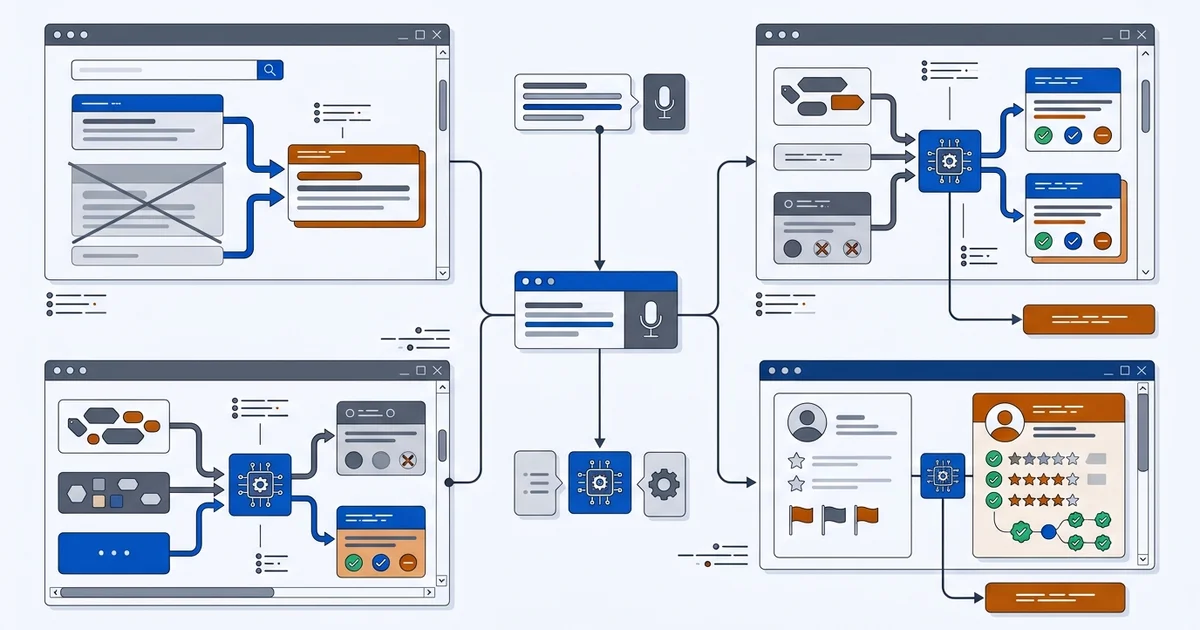
Start by confirming what you are actually seeing
Before diagnosing anything, run the test properly. Log out, use the phrasing a customer would use, and never include your business name in the prompt. Asking “is my business good” proves only that you exist. Asking “who repairs commercial fridges in Springvale” tests the thing you care about.
Then read the citations under the answer, not just the paragraph. Those sources tell you what the engine could see, which is the fastest route to the cause. The mechanics behind this are in Lesson 1: how AI search picks local businesses, and how RAG decides which local business to name explains why the citation list is the evidence that matters.
Once you have a real result, there are three usual causes. Work through them in order, because fixing the third while the first is broken wastes the effort.
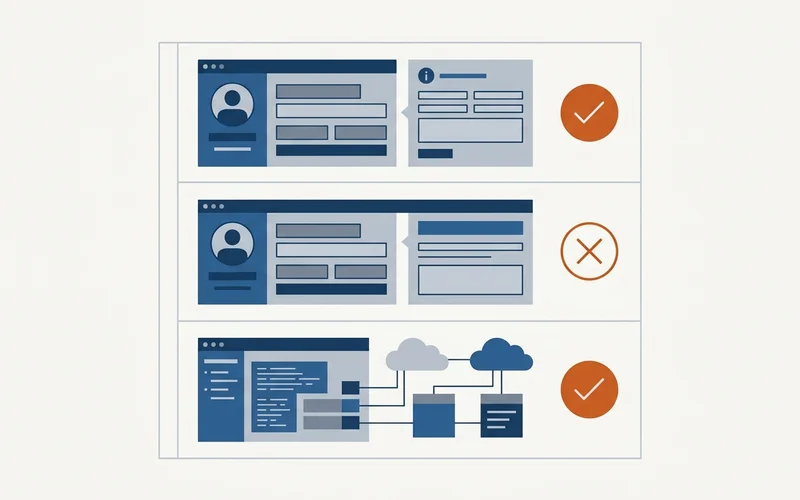
Cause one: a thin or inconsistent business profile
This is the most common by a distance.
Check it, ten minutes. Open your Google Business Profile. Is the primary category the most specific one that fits? Are hours current, including special hours? Is the phone number the one you actually answer? Are services listed? Then search your business name and your phone number and compare what other sites say.
The failure it causes. Contradictory facts make an engine hedge or prefer a business whose facts are unanimous. An assistant will not confidently state hours it has seen three versions of.
The fix. Complete the profile properly, then make every listing agree with it. The NAP consistency guide has the audit worksheet, and Lesson 2 covers the full pass.
Cause two: no page worth quoting
Check it, ten minutes. Open the page that should win this query. Find a single paragraph that answers the customer’s question directly, contains a checkable fact, and makes sense if read alone. If you cannot find one, an assistant cannot either.
The failure it causes. You are not being outranked, you are being skipped. Retrieval works at passage level, so a page of confident adjectives offers nothing to lift into a sentence.
The fix. Rewrite one page: question as heading, answer in the first sentence, specific fact underneath, service area and price range stated plainly. The guide on what makes a page quotable has before-and-after examples, and Lesson 3 covers the full structure.
Cause three: stale third-party data
Check it, ten minutes. Search your business name plus your suburb and read the first two pages of results. Look for old addresses, disconnected numbers, a listing for a location you closed, or a directory entry describing services you no longer offer.
The failure it causes. Third-party sources are treated as corroboration, so an out-of-date one actively argues against your own site. Worse, many small directories refresh from data aggregators, so fixing ten listings individually can be undone by one stale upstream record.
The fix. Correct the major aggregators first, then the directories that actually send you traffic, then stop. Lesson 6 explains why chasing hundreds of listings has no payoff.
What to fix first, and why order matters
Profile, then page, then third-party data. The reason is dependency: a rewritten page that states hours your profile contradicts has created a new inconsistency rather than fixing one. Getting your own facts straight first means every later change reinforces the same story.
Allow weeks, not days, for results to move. Engines re-crawl on their own schedule, and anything involving aggregator propagation can take a couple of months.
When the competitor genuinely deserves it
Sometimes the honest answer is that they are a better match for the question. They may have a page specifically about the thing asked, weekend hours you do not offer, or reviews that repeatedly name the exact service in the query.
That is useful information, not a defeat. Read their page and note what it answers that yours does not. If they have published a price range and you have not, that is a decision you can change this afternoon.
If the same competitor is named across every prompt in your set and your foundation is genuinely clean, you are looking at a competitive displacement problem rather than a visibility problem, which Lesson 8 addresses directly.
Sometimes the query has no good answer yet
One honest caveat before you spend a quarter chasing a result.
Some questions are too vague for any engine to answer well. “Best tradesperson near me” with no service named, no constraint and no location precision produces a hedge or a list of whoever is most prominent regionally. That is not a signal about your business.
Some categories are also thinly covered. If almost nobody in your sector has published specific, citable information locally, assistants will lean on directories and generic national pages, and no amount of work on your side changes the shape of the answer in the short term. The upside is that this situation is an opportunity: the first business in a thin category to publish genuinely specific answers tends to become the default source.
Test with the specific questions your customers actually ask, not with broad category terms. If your prompt set is specific and you are still absent, the three causes above apply. If your prompt set is vague, fix the prompt set first, using the method in the guide on testing whether ChatGPT recommends your business.
A 30-minute diagnostic run
If you have half an hour right now, do this in order and write down what you find.
- Minutes 0 to 5. Run three customer-style prompts logged out. Record who is named and which sources are cited.
- Minutes 5 to 15. Open your business profile. Check category, hours, phone and services against reality.
- Minutes 15 to 25. Search your business name and your phone number. List every mismatch you find.
- Minutes 25 to 30. Open the page that should win the query and look for one self-contained, specific paragraph.
At the end you will have a ranked problem list rather than a vague worry. In most cases the top item is a contradiction you can fix this week, not a content project that takes a quarter.