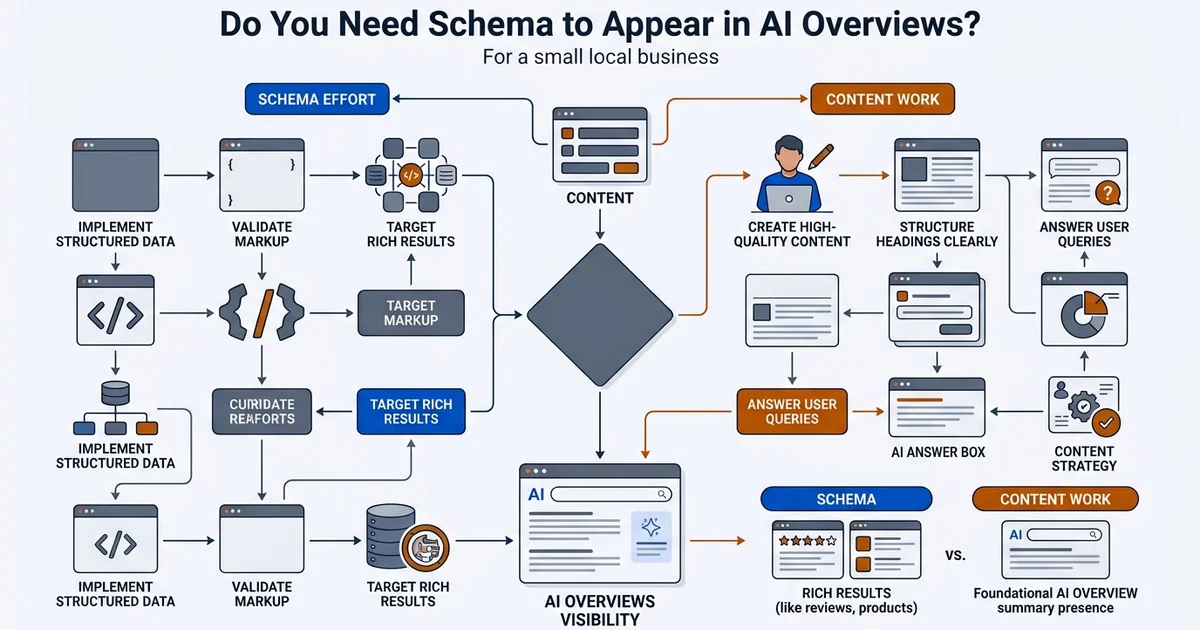
The direct answer
No, you do not need schema to appear in AI Overviews. Plenty of businesses are cited with no structured data at all.
What schema does is reduce ambiguity about who you are and what you offer. That is worth real money when your identity is unclear, and close to nothing when it is already obvious from clean listings and a clear website.
Anyone telling you structured data is a requirement for AI visibility is either selling implementation or repeating something they read. The fuller treatment is in Lesson 4: schema and structured data for local AI SEO, which is explicit about the limits.
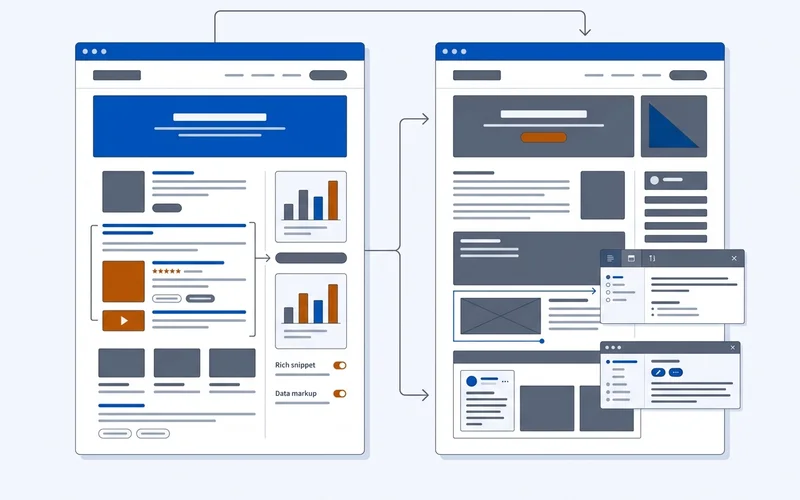
What schema demonstrably helps with
Entity resolution. When several businesses share a name in a region, or you trade under a name that differs from your registered one, structured data states plainly which entity your site describes.
Fact reliability. Hours, phone number and address stated in a machine-readable format are harder to misread than the same details inferred from a footer or an image.
Coverage claims. areaServed is a clean way to state where you work without inventing location pages, as the
areaServed guide describes.
Rich result eligibility. Separate from AI answers, but a real benefit in classic search surfaces.
Profile linkage. sameAs connects scattered profiles into one identity, which is often the single most useful
line in the block.
What it does not do
It does not make a thin page quotable. It does not compensate for listings that contradict each other. It is not a declared ranking factor for AI Overviews, and there is no threshold of markup completeness that unlocks citation.
It also cannot manufacture authority. Marking up a rating collected on a third-party platform is against the guidelines, and adding more properties does not increase trust in the underlying facts.
Who should add it now
- Businesses with an ambiguous identity: a shared name, a recent rebrand, a trading name that differs from the legal entity.
- Service-area businesses with no public address, where markup carries facts a hidden address would otherwise supply.
- Multi-town operators who need to state coverage without publishing thin location pages.
- Anyone whose site is already clear and whose listings already agree, since markup is the obvious next increment.
- Anyone whose platform makes it a ten-minute job through a plugin or settings panel.
Who should wait
- Sites with no page that answers a real buyer question specifically. Fix that first, using the guide on what makes a page quotable.
- Businesses whose listings still contradict each other. Markup will faithfully describe a business the rest of the web disagrees about.
- Anyone who would have to pay a developer several hundred for a first pass while their profile is still half complete.
The order that works is: profile, then pages, then markup. Schema is the third step because it describes facts the first two steps make true.
How to decide for your own site
Three questions.
Could someone confuse my business with another? If yes, schema earns its place today.
Do my key pages contain specific, checkable answers? If no, that is the higher priority.
How much effort is it on my platform? A plugin setting is ten minutes and worth doing regardless. A developer engagement is a decision that should wait behind the first two questions.
Whatever you decide, make the call deliberately. The worst outcome is spending a week on markup while your hours are wrong in three directories, which is a problem no amount of valid JSON-LD will solve.
What the evidence actually shows
Being precise about the evidence matters, because this topic attracts confident claims in both directions.
Across LocusPilot’s local builds since December 2025, LocalBusiness markup was added on effectively every site, so there is no clean control group and no honest way to claim an isolated effect. What the builds do show is narrower and more useful.
On sites where the business entity was ambiguous, a service-area business with no public address, a business sharing a name with another in the same region, or a recent move with mixed records still circulating, structured data appeared to help engines settle on one identity. On sites whose facts were already unambiguous and consistent, adding markup rarely produced a visible change on its own.
That observation is dated September 2026 and comes from one publisher’s own work, not from an industry study. It is stated that way deliberately, in line with the editorial policy.
The sequencing argument
Even where schema helps, it helps second.
An engine deciding whether to name your business needs two things: confidence about who you are, and something worth saying about you. Structured data serves the first. Only your content serves the second.
So the order is content, then consistency, then markup, unless your identity is genuinely unclear, in which case markup moves up. That is the reasoning behind the sequence in the 90-day checklist, where schema sits in month two after the profile and listing work in month one.
If you are staring at an afternoon and cannot decide, ask one question: could a stranger reading my site work out exactly what I do, where, and roughly what it costs? If the answer is no, that is the afternoon’s work, and Lesson 3 is the place to start.