What sameAs actually does
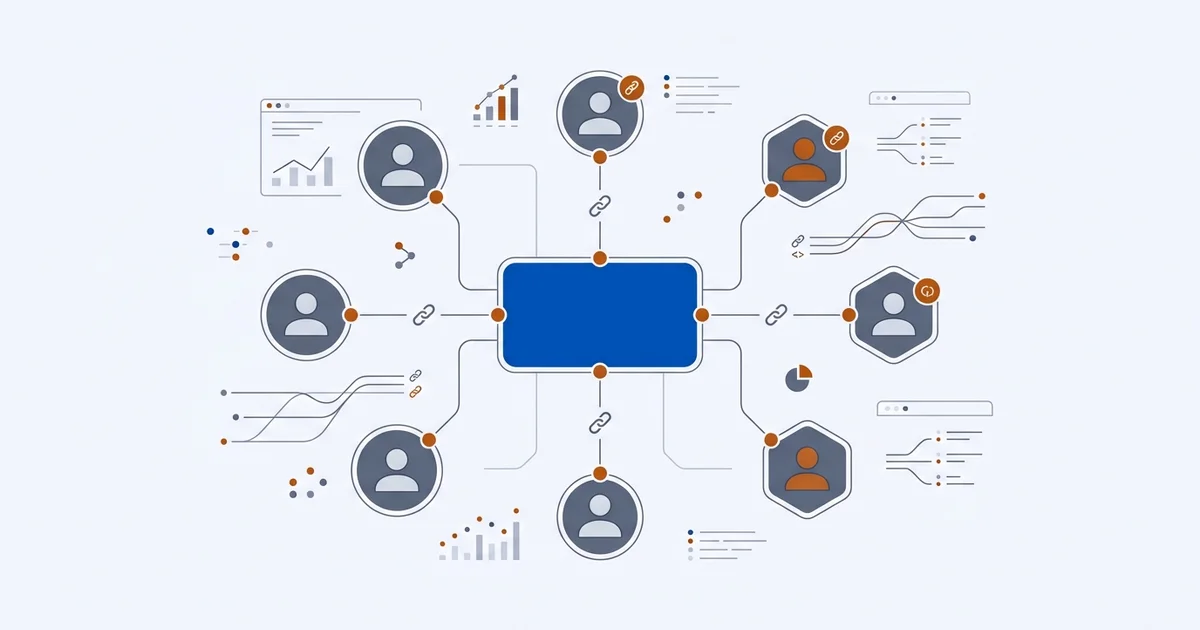
sameAs is a property that says: this entity is also the thing at these URLs. In a LocalBusiness block it lists the
external profiles that describe the same business.
The purpose is entity resolution. Engines encounter your business across a scattered set of records, your site,
Google Maps, Facebook, a trade directory, and have to work out whether they are one business or several. sameAs
answers that question explicitly instead of leaving it to inference.
For most local businesses, this is the highest-value part of a schema block after the basic facts, for the reasons set out in Lesson 4: schema and structured data for local AI SEO. If the block is not on your site yet, how to add JSON-LD to a local business site comes first.
Which profiles to list, and in what order
Order has no formal meaning, but putting the strongest first keeps the list maintainable.
- Your Google Business Profile, using the stable Maps URL for the listing.
- The primary social profile you actually use, whichever that is for your sector.
- Sector or trade directories where you are genuinely listed, such as a licensing body, a trade association or an industry marketplace.
- Other platforms you own and maintain, including a company LinkedIn page, a booking platform profile or a supplier’s approved-installer listing.
- Apple Business Connect and Bing Places listings, if they have stable public URLs.
Three to eight entries is typical. There is no benefit in padding.
What not to list
Profiles you do not control. A directory listing someone else created is a citation, not an identity claim. Citations and mentions are a different mechanism.
Dead profiles. An account last updated in 2019 with a wrong phone number is a weak signal and an active inconsistency.
Aspirational links. A Wikipedia article about your industry, a manufacturer’s homepage, a chamber of commerce
you are not a member of. sameAs means “this is also me”, and anything else is noise.
Personal profiles for a company entity. Your own LinkedIn belongs on a Person entity, not the business one.
A worked block
{
  "@context": "https://schema.org",
  "@type": "Electrician",
  "@id": "https://example.com/#organization",
  "name": "Example Electrical",
  "url": "https://example.com/",
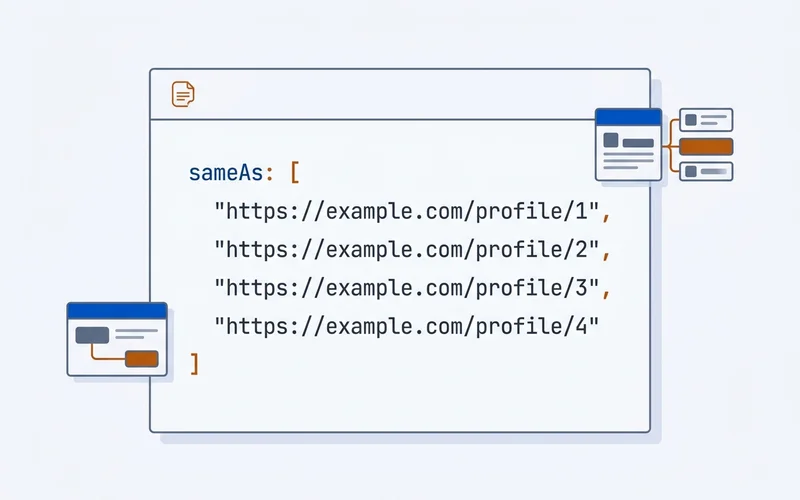
  "sameAs": [
    "https://www.google.com/maps/place/?q=place_id:EXAMPLE_PLACE_ID",
    "https://www.facebook.com/exampleelectrical",
    "https://www.linkedin.com/company/exampleelectrical",
    "https://www.instagram.com/exampleelectrical"
  ]
}
Every URL must resolve to a live page describing the same business, with details matching the rest of your
footprint. A sameAs pointing at a profile that lists your old number reintroduces the contradiction problem inside
your own markup.
Do you need Wikidata?
Almost certainly not.
Wikidata is an open structured-data project with notability expectations. A local plumbing company with no press coverage does not meet them, and an item created anyway is likely to be deleted. Time spent there is time not spent on your profile or your service pages.
The exception is a business that genuinely has independent coverage: a long-established local institution, a business with substantial press, or an organisation with a public role. If that describes you, a Wikidata item is a reasonable addition. If it does not, skip it without concern.
Checking the links stay live
Profiles get renamed, URLs change, platforms shut down. Add a sameAs check to the twice-yearly audit described in
the NAP consistency guide: click every link in the array, confirm it loads, and
confirm the details on the other end still match your canonical record.
Five minutes, twice a year, keeps the block honest.
How sameAs fits with citations and mentions
It helps to keep three related things separate, because they are often confused.
sameAs is a claim you make: these external profiles are me. It belongs to you and lives in your markup.
A structured citation is a third-party record of your details on somebody else’s site. You do not control it, and its value is corroboration.
An unstructured mention is your name in ordinary text on somebody else’s page. Also not yours, and it carries different information.
An engine cross-checks all three. Your sameAs claim points at a profile; that profile carries details; those
details either match your site or they do not. When they match, you have strengthened entity resolution. When they
do not, you have handed an engine a contradiction with your own signature on it.
That is why the audit step matters more here than the length of the array. The citations versus brand mentions guide covers the other two mechanisms in detail.
A short maintenance routine
Twice a year, as part of the listing audit:
- Click every URL in your
sameAsarray and confirm it loads. - On each profile, check the business name, phone and address or service areas against your canonical record.
- Remove any profile you have stopped maintaining, or update it and keep it.
- Add any new profile you genuinely own, such as a newly claimed platform listing.
- Re-validate the markup afterwards, since a typo in an edited array breaks the whole block.
Five minutes, twice a year. The failure mode it prevents is a block that quietly points at a dead profile carrying a phone number you have not used since 2023.