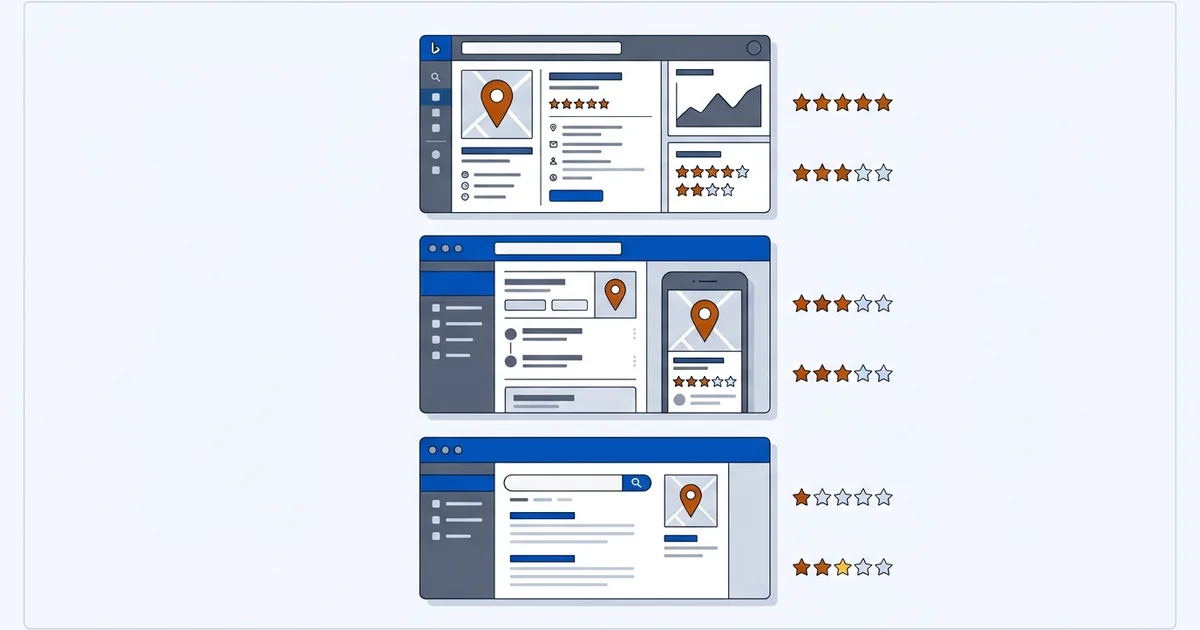
Three profiles, very different returns
Claiming every business profile on the internet is a familiar piece of advice and a poor use of a Saturday. Three are worth your time, and they are not worth equal amounts of it.
The reasoning behind prioritising profile work at all is in Lesson 2: Google Business Profile for AI search. This guide is about sequencing it when time is short.

Google Business Profile
Who reads it. Google Search, Google Maps, Google AI Overviews and Gemini surfaces. For local queries it is the single densest structured record of your business facts available to any engine.
Effort. Two to three hours to claim, verify and complete properly. Twenty minutes a month after that.
Payoff. The highest of the three by a distance. If you do nothing else, do this.
Watch for. Verification can take days and occasionally requires a postcard or video. Start it before you need it.
Apple Business Connect
Who reads it. Apple Maps, Siri and Apple’s own surfaces. It does not feed ChatGPT, Perplexity or Google.
Effort. Roughly an hour to claim and complete. Very little ongoing.
Payoff. Moderate, and highly dependent on your customer base. If you serve a consumer market in a high-iPhone-ownership region, map accuracy in Apple Maps matters for real-world visits. If you are B2B and phone-led, it matters less.
Watch for. Apple’s category taxonomy differs from Google’s, so pick the closest accurate match rather than forcing an exact mirror.
Bing Places
Who reads it. Bing search, Copilot surfaces, and several assistants and products that draw on Bing’s index for web results.
Effort. Under an hour, and Bing offers import from Google, which does most of the work. Almost no upkeep.
Payoff. Low to moderate on its own, but the cost is so small that the ratio is good. Worth doing once and then largely forgetting, other than at your twice-yearly audit.
Watch for. The import can carry across formatting that differs from your canonical form. Check every field after importing rather than assuming it copied cleanly.
The claiming order
| Order | Platform | Time | Why here |
|---|---|---|---|
| 1 | Google Business Profile | 2-3 hrs | Densest record, largest surface, feeds AI Overviews |
| 2 | Bing Places | under 1 hr | Cheapest win, import from Google, feeds Bing-backed assistants |
| 3 | Apple Business Connect | ~1 hr | Matters for Apple Maps and Siri, consumer-heavy businesses most |
Do them in that order, and finish each one before starting the next. A half-completed profile on three platforms is worse than one complete profile, because partial records are where inconsistencies breed.
Keeping three profiles consistent without tripling the work
One canonical record, three copies.
Write your canonical details in a single document: exact business name, exact address format or service area list, public phone number, hours, primary category equivalent on each platform, and the URL you point at. Every profile is filled from that document, never from memory.
When something changes, update the document first, then each profile in the same session. Then run the listing audit from the NAP consistency guide at your next scheduled check to catch anything downstream that did not follow.
What not to bother with
Beyond these three, additional profile platforms have sharply diminishing returns for a local business. Sector directories where your customers genuinely look are worth claiming; generic directories that exist to sell upgrades are not.
Lesson 6 covers where the line sits and why directory volume plateaus faster than most owners expect.
What to do once all three are live
Claiming is the project. Keeping them aligned is the habit, and it is much smaller.
At each monthly profile check, update the platform where something actually changed, then mirror it to the other two in the same sitting. Changing hours on one and not the others is how a clean setup becomes a contradictory one.
At each twice-yearly audit, open all three side by side and compare every field against your canonical record: name, address or service area, phone, category equivalent, hours, website URL, services.
After any business change, treat the sequence as one task: canonical record first, then Google, then Bing, then Apple, then the aggregators, then the directories that matter. Doing them piecemeal over several weeks is what creates drift.
Why three profiles is the stopping point
Beyond these three, additional platforms have sharply diminishing returns, and each one adds a surface where your details can fall out of sync.
Two categories are worth an exception. A sector platform your customers genuinely use, such as a trade marketplace or a booking system common in your industry, is worth claiming because it drives real enquiries. And a licensing body or trade association register carries authority that a generic directory does not.
Everything else, particularly directories that exist to sell you an upgrade, can be skipped without cost. Lesson 6 explains why the returns on listing volume flatten so quickly, and where the same hours produce more value instead.