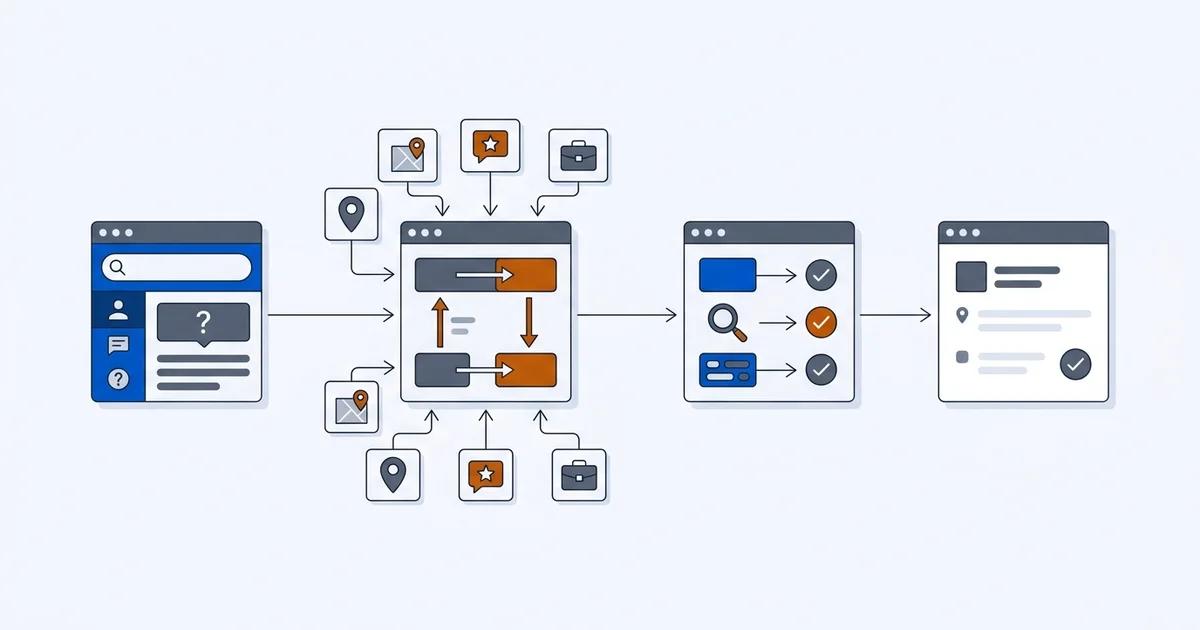
Four stages, one answer
Retrieval-augmented generation, or RAG, is the pattern behind most AI answers about local businesses. The model does not remember your opening hours. It fetches documents, reads them, and writes a sentence grounded in what it found.
Understanding the four stages tells you where your effort has any effect, which is the practical point of Lesson 1: how AI search picks local businesses.
Stage one: the query
The customer types something conversational: “who can fix a walk-in cooler tonight in Dandenong”. The system works out the intent, extracts the location, notices the urgency, and often rewrites the question into something more searchable before anything is fetched.
You cannot influence this stage. What you can do is notice the phrasing customers actually use, because those are the questions your pages should answer in their headings. Marketing language rarely matches it.
Stage two: retrieval
The system gathers candidate documents. For a local question that usually means three source types: business profile data, pages from business websites, and third-party sources such as directories, review platforms and local press.
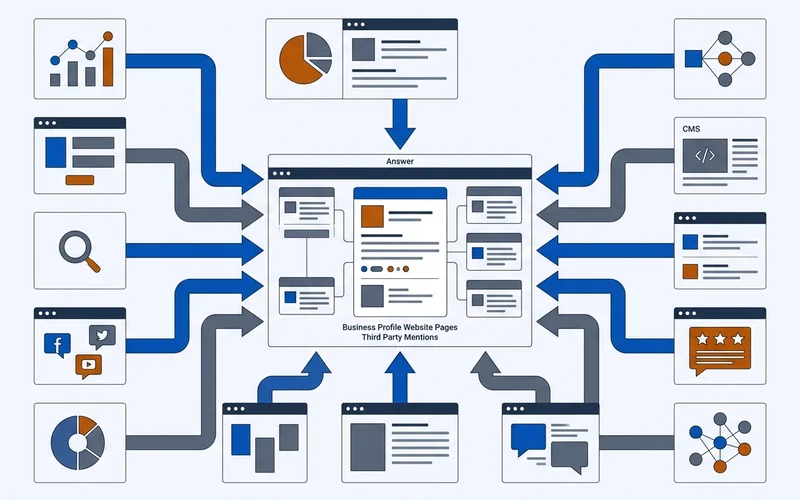
Retrieval is usually semantic rather than keyword-exact. Documents are compared by meaning using vector representations, which is why a page written in plain customer language can be pulled without containing the exact search phrase. It also means stuffing keywords does nothing useful.
Two practical consequences. First, your page has to exist in a form a fetcher can read, which is what which AI crawlers read your site covers. Second, your facts have to be findable in text, not buried in an image of a price list or a PDF nobody links to.
Stage three: grounding
The retrieved passages are attached to the prompt so the model writes from sources rather than from memory. This is the stage that decides whose facts end up in the sentence.
Grounding is also where contradictions do their damage. If your profile says you close at five, a directory says six, and your site says “by appointment”, the system has three incompatible claims about one business. The usual outcomes are hedging, picking whichever source it trusts most, or naming a competitor whose facts are unanimous.
Nothing about your writing style fixes that. Only agreement across sources does.
Stage four: the answer
The model writes a short response and, in most interfaces, attaches source links or cards. Those citations are useful to you for a reason most owners miss: they tell you which of your assets the engine could actually see.
Run the query yourself, logged out, and read the citations rather than the paragraph. If your site is never cited but a directory listing is, your pages are not being retrieved and that is your problem to solve. If nothing of yours appears at all, start with the profile and listing work in Lesson 2.
A worked example
A customer asks: “best place to service a commercial coffee machine near Footscray, open Saturday”.
- Query. Intent is local service, with a constraint on weekend opening.
- Retrieval. Candidates come back: three business profiles, two service pages, one directory listing, one forum thread.
- Grounding. Two of the three profiles list Saturday hours. One of those two has a service page explicitly naming commercial espresso machines and stating a Saturday callout fee. The third business services machines on Saturdays but says so nowhere.
- Answer. The business with the explicit, corroborated Saturday detail gets named. The third business is invisible, not because it is worse, but because nothing it published answered the constraint.
That is the whole mechanism in one example. The winner did not out-market anyone. It answered the question in a place the engine could read.
Where to intervene
In order of leverage: make your facts agree everywhere, publish specific answers to the questions customers actually ask, and make sure crawlers can fetch the pages holding them. The 90-day checklist sequences those into three months, and Lesson 1 explains why the order matters.
Why consistent facts beat clever copy
The stage-by-stage view explains something that frustrates a lot of owners: a well-written page can lose to a plain one.
At the grounding stage, the system is not judging prose quality. It is looking for claims it can restate without risk. A plain sentence stating a price, a suburb and a response window is low risk. A beautifully written paragraph that implies all three without stating any is high risk, because nothing in it can be checked against another source.
Add a contradiction anywhere in your footprint and the risk rises further. That is the mechanism behind the hedged answer: the system has retrieved two incompatible claims about one business and has no basis for choosing.
The practical rule that follows is worth keeping: when you are deciding between making a page more persuasive and making it more specific, choose specific. Persuasion works on the reader who has already been named a candidate. Specificity is what makes you a candidate.
What this means for your next hour
Three actions, each of which intervenes at a stage you can actually reach:
- Write down the five questions customers ask before booking. Those are retrieval targets. If none of your pages answers one of them directly, that is your first gap.
- Check one fact across three sources. Your phone number on your site, your profile and one directory. If they differ, you have found the grounding problem before it costs you an answer.
- Read the citations on one real query. Not the answer, the sources. That list is the clearest available picture of what the retrieval stage can currently see of your business.